
Aggregators
An aggregator is an organisation that onboards participants and brings their signals onto the network at scale — a training institute, employer, NGO, or government department. The Aggregator DPG is the application they use.
Why aggregators matter
Section titled “Why aggregators matter”Signal volume is the fuel for local discovery. Asking every citizen to self-onboard is slow; aggregators already hold relationships with hundreds or thousands of participants. By letting an aggregator register and bulk-load its participants, the network reaches useful signal density quickly — which is exactly what the Ghaziabad and Dharwad pilots demonstrated.
What the Aggregator DPG does
Section titled “What the Aggregator DPG does”The Aggregator DPG is aggregator-facing and provides:
- Registration & approval — an organisation registers, is reviewed, and is approved onto the network.
- Profile management — schema-driven forms (RJSF) let non-engineers evolve registration and profile fields without code changes.
- Bulk upload — CSV/file-based creation of many participant signals at once, processed asynchronously by a background worker.
- Registration links & metrics — shareable links for self-registration, with roll-up metrics.
The trust boundary
Section titled “The trust boundary”The Aggregator DPG reads from the upstream Signals stack and, in the MVP, has no write access to Signals except through the controlled bulk-create paths. Every request is scoped to a verified aggregator_id, which is never trusted from the client — it is asserted from the authenticated session. This keeps one aggregator from ever reading or writing another’s data.
Integrating DPGs (such as the Aggregator app, or a voice DPG) authenticate to Signals with a two-header service-auth model (x-api-key plus an acting-org header). See Identity & Auth for the full model.
Relationship to Signals
Section titled “Relationship to Signals”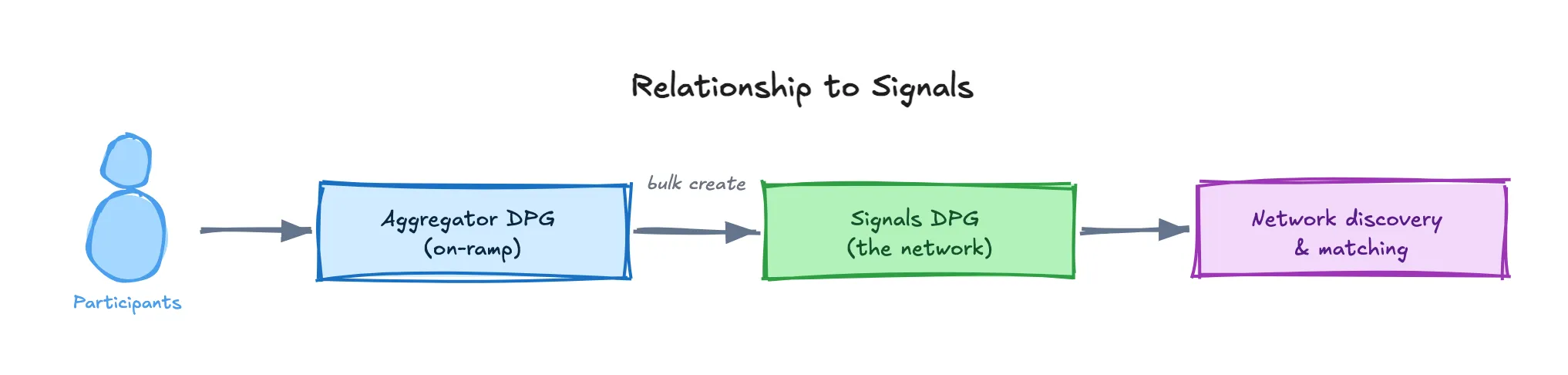
The Aggregator app is the on-ramp; the Signals DPG is the network. Adaptors usually stand up Signals first, then add the Aggregator app as partner organisations come on board.