
Items, Actions & Events
Inside an instance, everything is built from three primitives: items, actions and events.
An item is a versioned, schema-typed record — the unit of data in Signals. Examples: a participant profile_1.0, a job posting, a service offer.
item_typeis always a schema identifier such asprofile_1.0, never freeform text.item_instance_urlanditem_schema_urlare generated by the backend at creation time. Clients must not set them.- Item tables are partitioned in the database; queries use partition-aware helpers so the planner can prune efficiently.
Action
Section titled “Action”An action is an interaction between items — for example a seeker expressing interest in a provider’s posting, or an aggregator linking a participant to an opportunity. Actions are the verbs of the system.
An event is the structured result of an action — the durable, machine-readable record that “X expressed interest in Y at time T”. Events are what downstream analytics and impact measurement consume.
How they relate
Section titled “How they relate”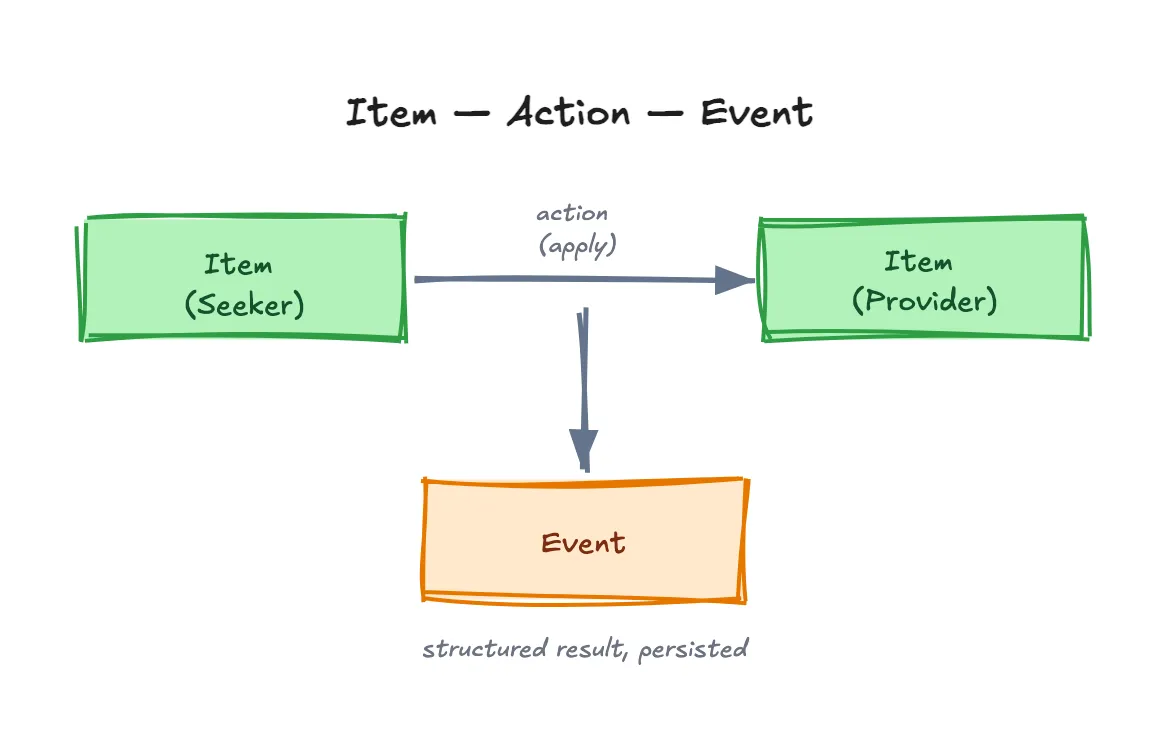
A signal lifecycle, in these terms:
- Create items for the seeker and provider.
- The network discovers compatible items.
- An action connects two items.
- An event records the outcome — feeding match-quality improvements and district-level impact metrics.
For how items are read locally vs. across the network, and how they are written, see Read & Write Paths. For the full term list, see the Glossary.