Use Cases
Blue Dots applies wherever seekers and providers are close in distance but invisible to each other. Livelihoods is the first and most developed use case; the same rails extend across sectors.
Livelihoods for youth
Section titled “Livelihoods for youth”The flagship use case. An ITI graduate looking for trade-specific work and a small business 800 metres away that needs exactly that skill currently never connect.
"I guess I will have to move to a city to find a job."
"I didn't realize there are 100s of relevant jobs in my vicinity!"
With Blue Dots:
- The graduate publishes a Blue Dot (often by voice).
- The employer’s need is captured as a complementary signal.
- The network surfaces the match within a day, two bus stops apart — keeping income and spending inside the district.
Pilot evidence: 10,000+ jobs surfaced from under 10% of local SMBs; discovery time cut from weeks to under a day; conversion above 50% in targeted drives. See Pilots.
Women’s workforce participation
Section titled “Women’s workforce participation”Local, proximity-aware discovery lowers the barriers that keep women’s labour-force participation under 35% — surfacing nearby, suitable work without long-distance migration.
"I don't want to travel more than 20 minutes for work."
"Spoke for 2 mins and I can now see remote work and roles just two bus stops away."
Government scheme uptake
Section titled “Government scheme uptake”Scheme budget utilisation sits below 70% largely because eligible citizens never discover relevant schemes. Modelling schemes as providers and citizens as seekers makes entitlements discoverable at the local level.
Local services
Section titled “Local services”Service uptake runs at under 50% of potential. Blue Dots connects citizens with nearby services they didn’t know existed — the same discovery pattern, a different domain. This is especially powerful for persons with disabilities, who often don’t know where to turn for the support that would let them start working.
"I don't know who to talk to for the support I need to start working."
"I just highlighted my needs and I can already see options for both work and services!"
The common pattern
Section titled “The common pattern”Every use case is the same shape:
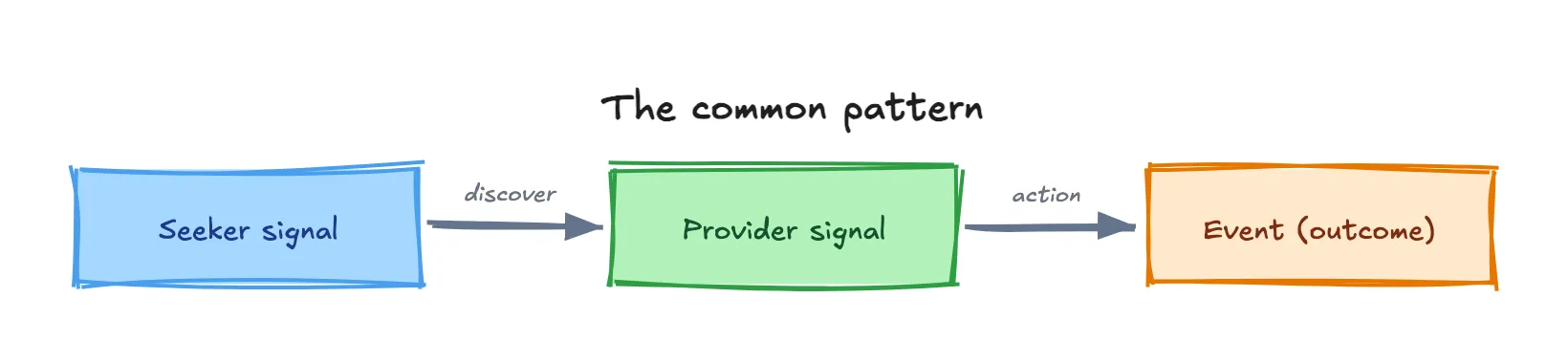
Adding a new use case means defining the domain and item schemas for it — not building a new system. See Beyond Livelihoods.