Networks, Domains & Instances
Three structural concepts make Blue Dots network-aware. They are distinct and should not be conflated.
Network
Section titled “Network”A network is the shared contract that lets independent deployments interoperate — for example blue_dot or yellow_dot. A network is defined by a network.json schema that specifies the item types, actions and events that participants on that network agree to speak.
Think of a network as a language: any instance that “speaks” the blue_dot network can discover and exchange signals with any other instance on it.
Domain
Section titled “Domain”A domain is a role inside a network — for example student. A single network can have many domains (seeker roles, provider roles, service roles). An instance declares which domains it serves through configuration (SERVED_DOMAINS).
Instance
Section titled “Instance”An instance is one deployment of the Signals API serving its configured domains. A district might run its own instance; a state program might run several. Instances are independent deployments that cooperate over the network contract — there is no central database every instance must share.
How they fit together
Section titled “How they fit together”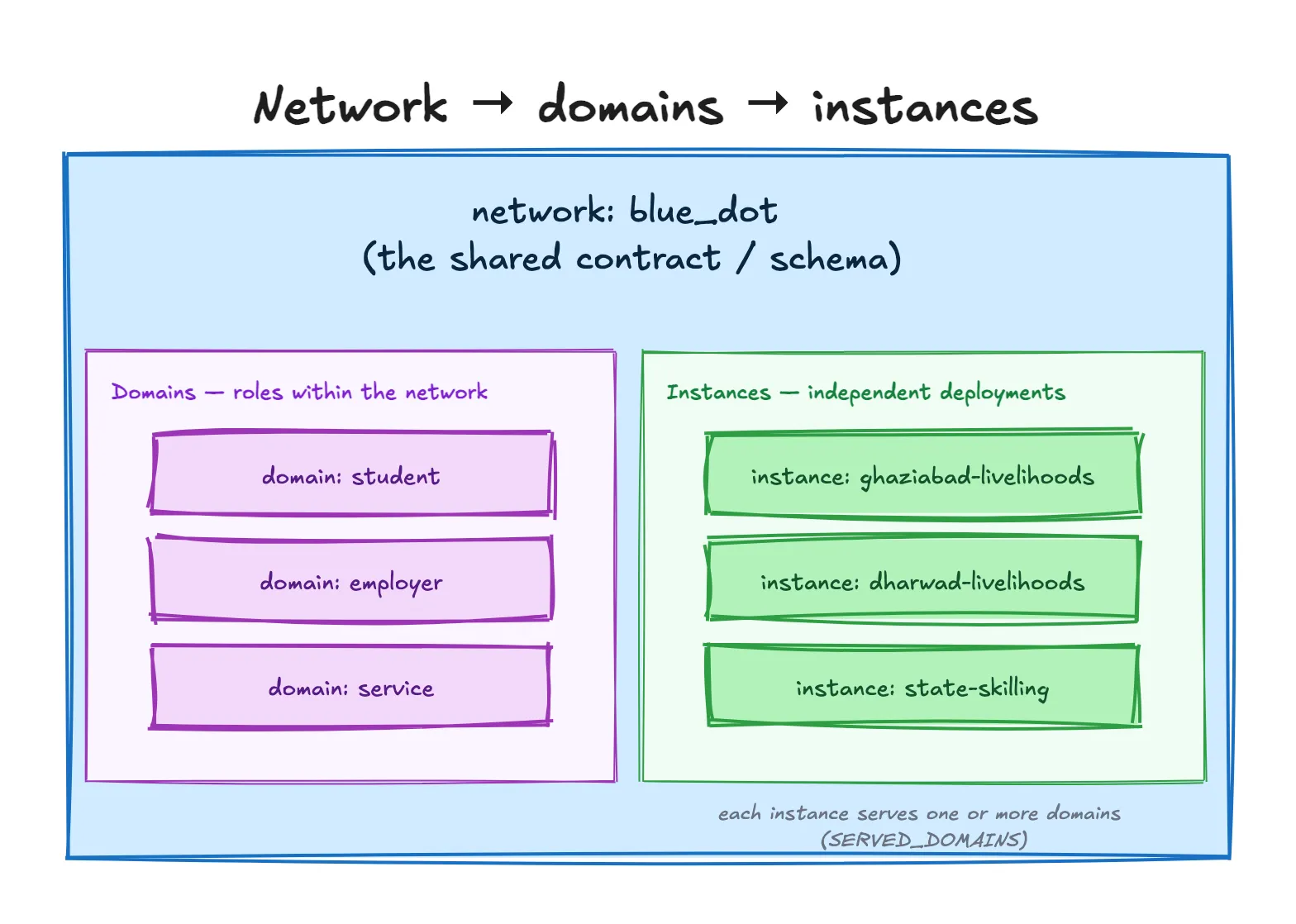
When you add a feature or a read endpoint, decide which network and domain it belongs to, and which instance layer it reads from, before writing code. The two read layers (instance-local vs. inter-instance) are covered in Read & Write Paths.