

Read & Write Paths
Signals keeps two read layers strictly separate. Before writing a read endpoint, decide which layer it belongs to.
Instance-local read
Section titled “Instance-local read”GET /api/v1/item/fetchReads an instance’s own items, backed by a brief Redis cache. Use this for “my own items” reads. It does not reach across the network.
Inter-instance read
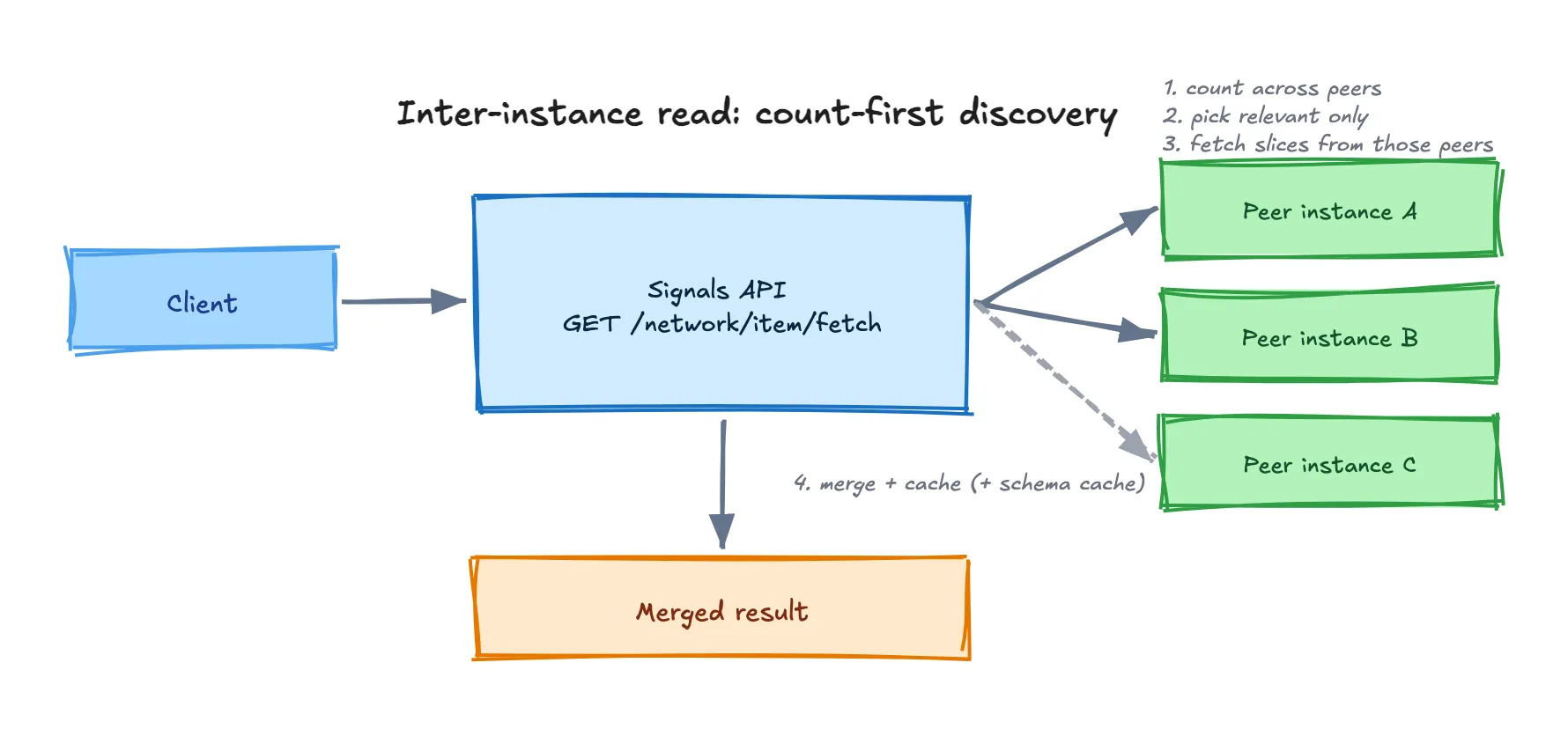
Section titled “Inter-instance read”GET /api/v1/network/item/fetchReads across instances using a count-first discovery strategy:
- Count first — ask peer instances how many relevant items they hold.
- Select peers — pick only the peers that actually have relevant items.
- Fetch slices — request just the needed slices from those peers.
- Merge & cache — combine results and cache the merged view. Schema fetching and caching live in this layer, not in the instance-local layer.
This avoids the naive “every instance queries every other” fan-out and is the core scaling decision of the network.
Write paths
Section titled “Write paths”Writes into Signals are deliberately constrained:
- The Signals UI / direct clients create items through the authenticated session path.
- Integrating DPGs (Aggregator app, voice DPG) write through controlled bulk-create paths using the two-header service-auth model. In the MVP the Aggregator has no other write access to Signals.
- On write, the backend generates
item_instance_urlanditem_schema_url; clients cannot set them.
Reliability rules for writes and external calls
Section titled “Reliability rules for writes and external calls”Every external call (including cross-instance fetches and writes) must have an explicit timeout, at least one retry with exponential backoff, and a typed error. Routes never throw — they return reply.code(N).send({ error, message }), handling Postgres 23505 (unique violation) and 23503 (FK violation) explicitly.