Aggregator DPG Architecture
The Aggregator DPG is the aggregator-facing application of the Blue Dots ecosystem. It is a pnpm + Turbo monorepo, TypeScript-only, with three deployable apps.
Three deployable apps
Section titled “Three deployable apps”api— Fastify backend-for-frontend. Owns the Aggregator database (Drizzle + Postgres), the Keycloak admin integration, and the registration/approval flow, bulk-upload entry point, registration links and profile endpoints. Reads the upstream Signals stack; in the MVP it has no write access to Signals except via the bulk-create paths. Every handler assertssession.aggregator_id— which is never trusted from the client.web— Next.js 15 (App Router) portal plus its own BFF. Anonymous flows use a service-account token; authenticated flows attach the user’s OIDC token. Sessions are signed cookies backed by Redis. Forms are RJSF-driven from JSON schemas, so non-engineers can evolve registration/profile forms without code changes.worker— BullMQ jobs:bulk-file-process,bulk-row-process,bulk-finalise,cron-watchdog,link-metrics-rollup. Shares the same DB schema, S3 and the Signals writer. Cron-style jobs are watchdogged.
Shared packages
Section titled “Shared packages”Cross-package consumption goes through subpath exports. The common pattern: each service package exports ./interface (an abstract class + Zod schemas), one or more concrete implementations (./postgres, ./http, ./memory), and ./testing (in-memory fake + builders). Apps import only from ./interface and ./testing.
Key packages include shared-primitives (a Result<T, E> type, a typed error hierarchy, branded IDs, shared DTOs), db-schema (the single source of truth for tables), signalstack-writer / participants-writer, queue (BullMQ wiring) and config loaders.
Architectural guardrails
Section titled “Architectural guardrails”These are enforced at CI by dependency-cruiser:
no-cross-service-impl-imports— cross-package imports must go through./interfaceor./testing.no-heavy-deps-in-interface— interface files may only importshared-primitives,zodornode:*.
Other non-negotiable rules: every cross-package contract is an abstract class (not a TS interface, so it survives at runtime as a DI token); service methods return Result<T, BaseError> and never throw across a boundary; every external call has an explicit timeout, retry with backoff and a typed error.
Data flow
Section titled “Data flow”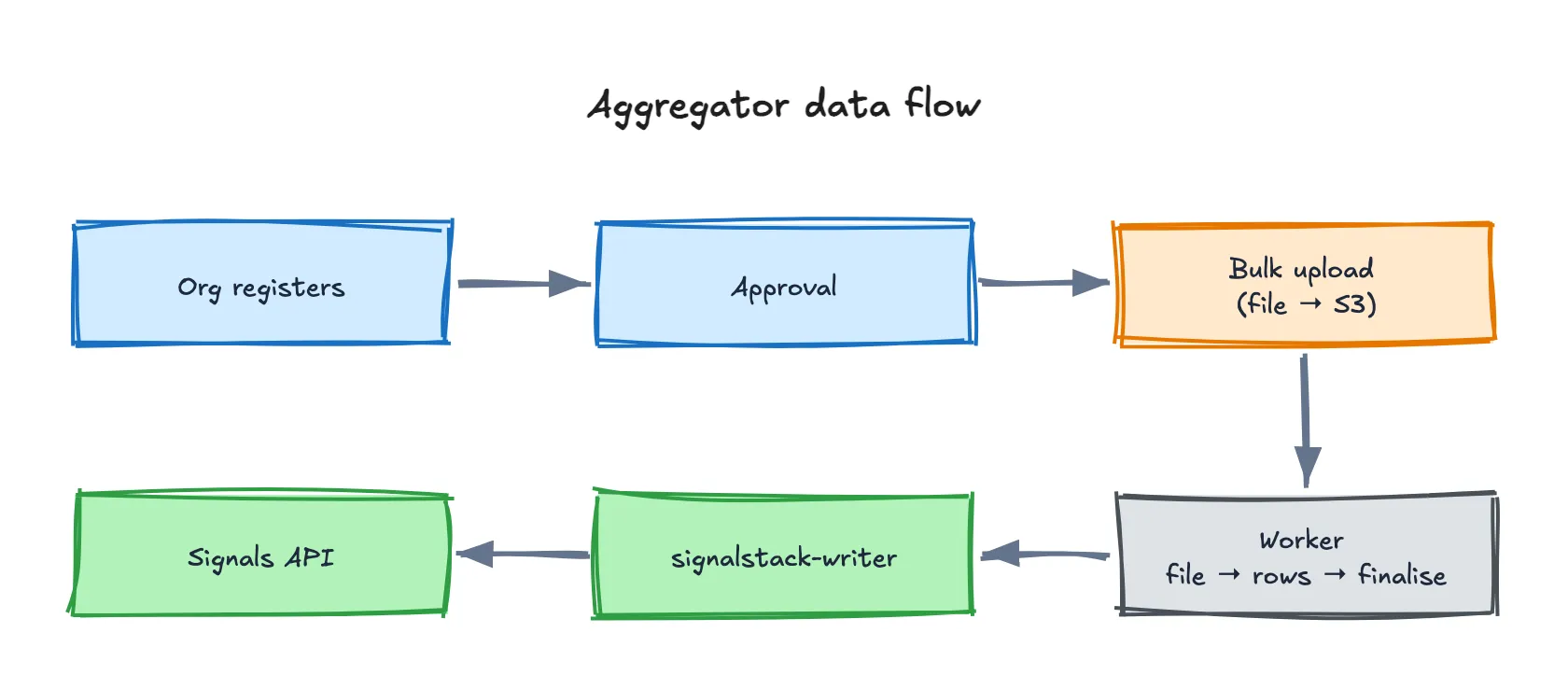
See Identity & Auth for the Keycloak setup and the service-auth handshake with Signals.