

Infrastructure & Deployment Architecture
This page describes how a Blue Dots deployment is provisioned and run on a cluster. It is grounded in the bluedots-automation repository, which does two things: provisions AWS infrastructure with OpenTofu + Terragrunt, and deploys the application stack with Helm. A single install.sh per environment is the entrypoint for both.
Two layers
Section titled “Two layers”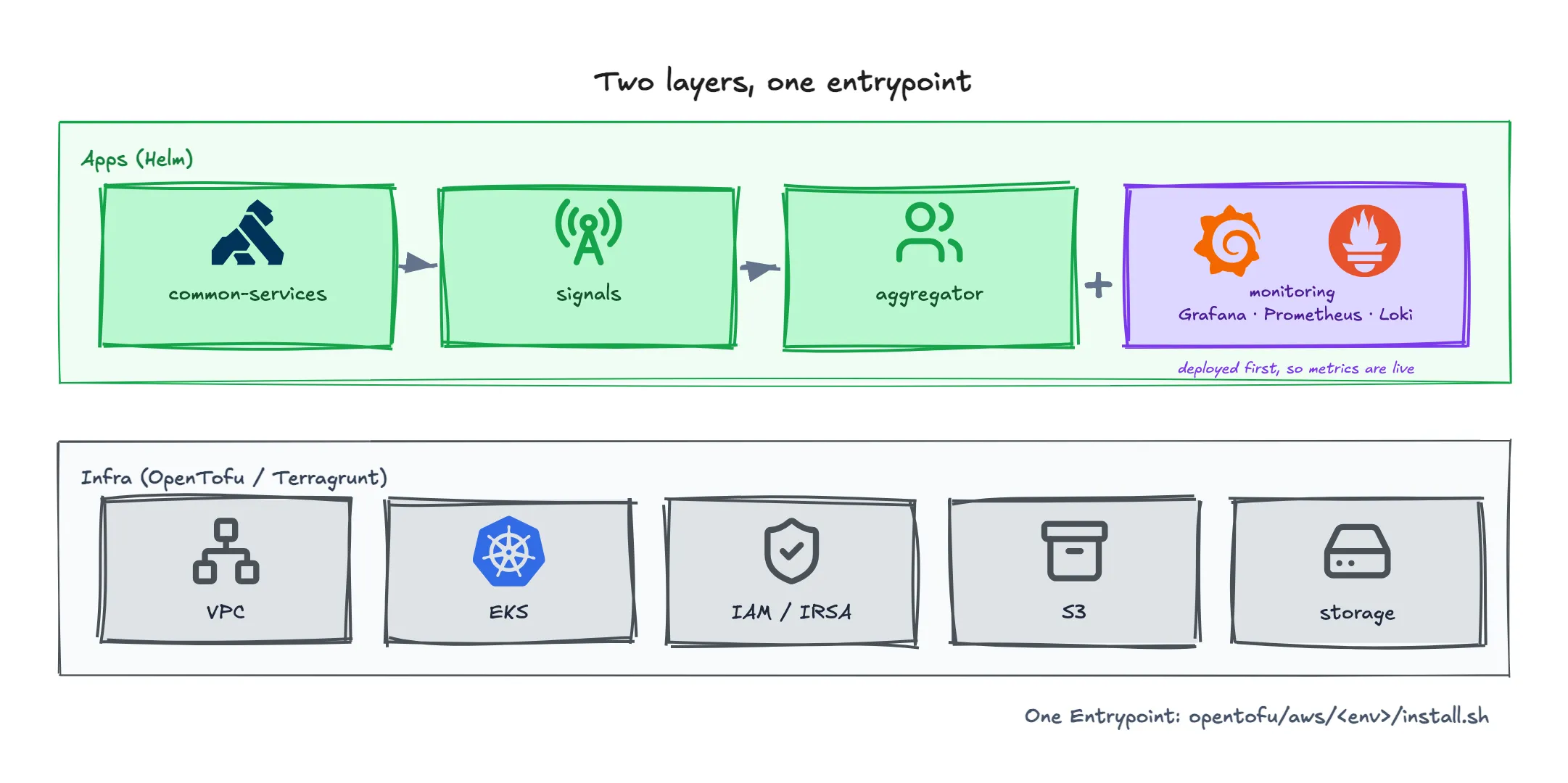
Infrastructure: OpenTofu + Terragrunt
Section titled “Infrastructure: OpenTofu + Terragrunt”Infrastructure is defined as code under opentofu/aws/. Each environment is a directory (opentofu/aws/<env>/) created by copying template/. Terragrunt wraps OpenTofu to give per-module state and dependency wiring; modules apply in order:

| Module | Provisions |
|---|---|
network | VPC, subnets, routing |
eks | the EKS cluster and node group |
iam | IAM roles incl. IRSA (service-account → role) |
storage | storage resources; gp3 is made the default StorageClass |
random_passwords | generated Postgres/Redis credentials |
output-file | generates the per-chart Helm values files (see below) |
The only file you normally edit per environment is global-values.yaml — region, EKS sizing, public hostnames, network/domains, SMTP/SMS, and alert recipients. A tf.sh file carries the AWS region and the remote-state S3 bucket name and is sourced before any terragrunt run.
Per-module plan/apply functions exist (apply_tf_eks, etc.) and honour AUTO_APPROVE=1 for non-interactive runs.
The generated values-file model
Section titled “The generated values-file model”Helm charts never hardcode secrets or hostnames. The output-file module reads outputs from the other modules and templates one values file per chart at the YAML root level, so Helm consumes each with a single -f — no slicing, no yq:
opentofu/aws/<env>/common-services-values.yamlopentofu/aws/<env>/signals-values.yamlopentofu/aws/<env>/aggregator-values.yamlShared secrets (e.g. the Redis password used by all charts) are templated into each file from the same random_passwords value, so they can never drift. Re-running terragrunt apply on the output-file unit regenerates and overwrites these files — so any manual edits must be applied after the final apply, or baked into the .tfpl templates.
Alongside these, three checked-in config files feed every deploy:
global-values.yaml— non-secret config (hosts, network, served domains).global-images.yaml— per-environment image pins (see CI/CD & Build Pipeline).helm/global-resources.yaml— replica counts, HPA, PDB and container resources, shared across environments.
Application stack: Helm umbrella charts
Section titled “Application stack: Helm umbrella charts”Three umbrella charts (plus a monitoring chart) deploy in strict dependency order:
| # | Chart dir | Namespace | Deploys |
|---|---|---|---|
| 1 | helm/common-services | common-services | Kong ingress controller, cert-manager, letsencrypt-prod issuer, shared Postgres + Redis |
| 2 | helm/signals | signals | Signals: api, ui, notification-service, match-score, search |
| 3 | helm/aggregator | aggregator | Aggregator: web (BFF), api, worker, keycloak |
| — | helm/monitoring | monitoring | Prometheus, Alertmanager, Loki, Alloy, Grafana (deployed first so metrics are live) |
common-services must be healthy (Postgres + Redis Ready, PVCs bound) before signals and aggregator, which connect to the shared datastores at …svc.cluster.local. The aggregator’s Keycloak init job runs after Postgres is Ready, making it the slowest release.
Deployment topology
Section titled “Deployment topology”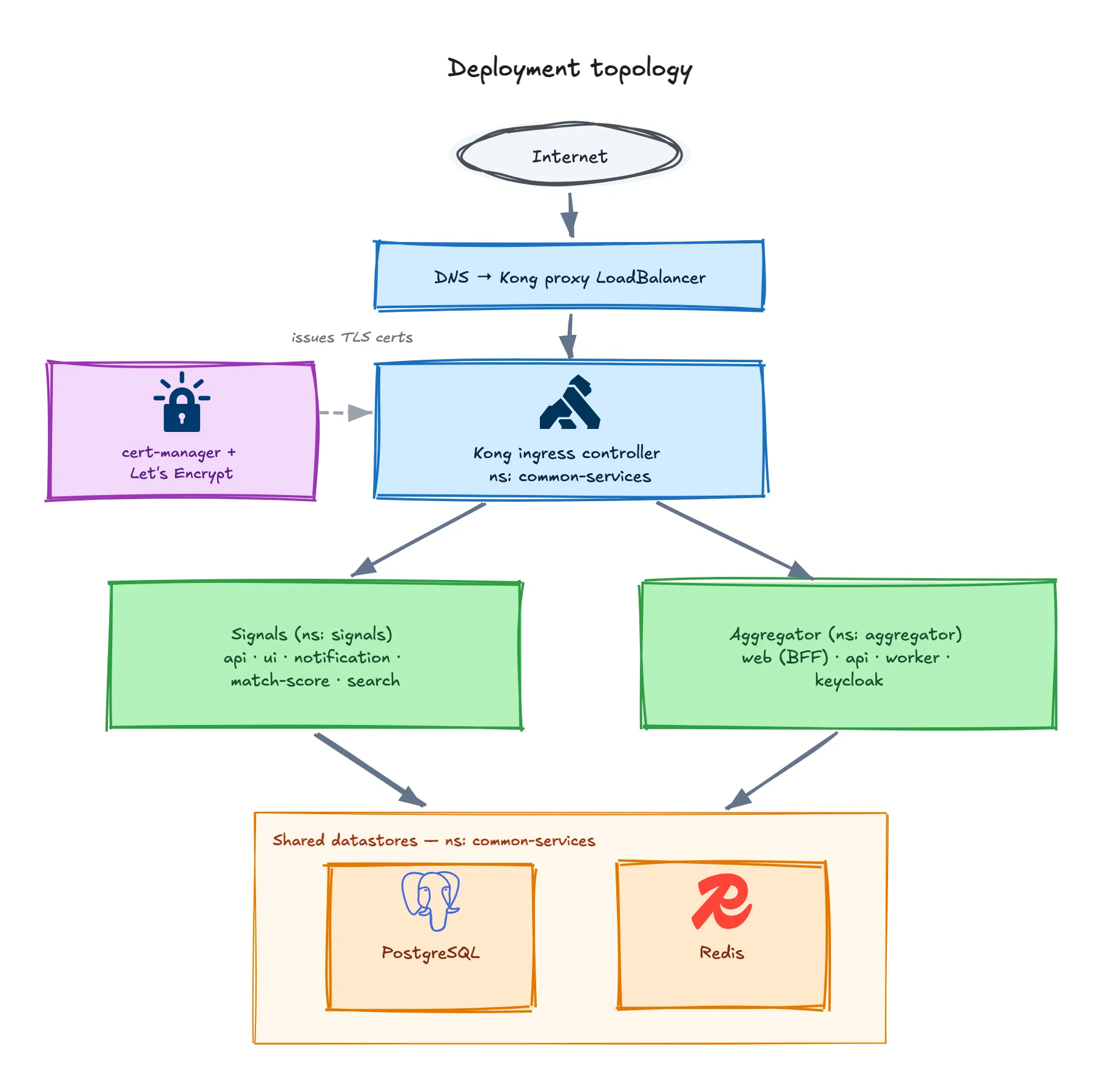
Ingress & rate limiting: Kong
Section titled “Ingress & rate limiting: Kong”common-services runs the Kong ingress controller (DB-less) as the sole controller; kong is the cluster-default IngressClass and every app Ingress sets ingressClassName: kong. Rate limiting is enforced by KongClusterPlugin tiers (rl-auth, rl-api, rl-public) attached per route via the konghq.com/plugins annotation, with counters backed by the shared Redis (policy: redis) so limits hold across Kong replicas.
Kong’s CRDs ship inside the vendored subchart, but Helm only installs subchart CRDs on first install and never updates them on upgrade — so deploy_common_services applies the CRDs explicitly (kubectl apply --server-side) before every Helm run.
TLS: cert-manager + Let’s Encrypt
Section titled “TLS: cert-manager + Let’s Encrypt”common-services installs cert-manager and a letsencrypt-prod ClusterIssuer. Certificates are issued automatically via ACME once DNS for the public hosts points at the Kong proxy LoadBalancer. (A known cert-manager v1.20.2 ACME bug is worked around by a fix_acme_issuer_uri step in install.sh.)
Identity at runtime
Section titled “Identity at runtime”Keycloak (Aggregator) and Better-Auth + API keys (Signals) are covered in Identity & Auth. One deployment-time detail: the aggregator’s global.signalstack.actingOrgId must be set after Signals is deployed (it is read from the seeded organization table via get-signalstack-org-id.sh), or aggregator login fails with SIGNALSTACK_ORG_NOT_REGISTERED.
Where to go next
Section titled “Where to go next”- Run it: Deployment guide.
- Ship to it: CI/CD & Build Pipeline.
- Configure it: Configuration.